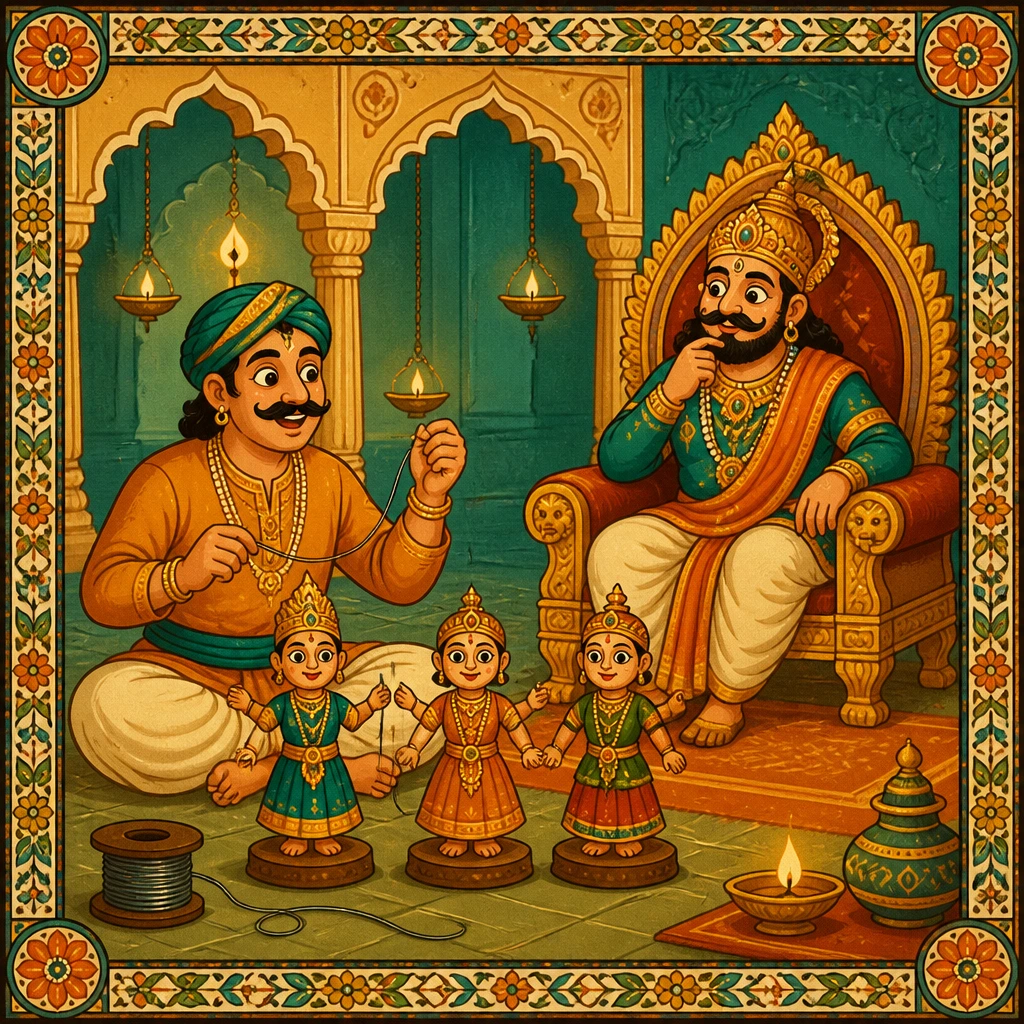
India has had many great kings. Many great warriors. Many great poets. But there was only one Tenali Raman — and this is his most famous story.
It is a rainy Tuesday evening, and eight-year-old Priya is bored.
Her phone is charging in the other room. The television is off. Outside, the rain drums steadily against the window of her family’s apartment in Pune. The room smells of warm chai and old books.
“Thatha,” she calls out to her grandfather. “I have nothing to do.”
Her grandfather appears in the doorway. He is a retired schoolteacher with a white moustache, quick eyes, and the particular look of someone who has a story ready and has been waiting to tell it.
“Nothing to do?” he says, settling into the armchair across from her. “In that case — let me give you a puzzle. A puzzle that once stumped an entire royal court, solved by the cleverest man who ever walked into a king’s palace.”
Priya sits up immediately. She loves puzzles.
“Tell me,” she says.
The King and the Merchant’s Challenge
Long ago, in the great city of Vijayanagara — so magnificent that travellers came from across the world just to see its golden towers — there ruled a king named Krishnadevaraya.
Krishnadevaraya was not just any king. He was a warrior, a poet, and a scholar. His court was famous across all of India for its brilliant minds — a circle of eight poets and thinkers so wise that people said they were the eight pillars holding up the sky of knowledge.
One morning, a merchant arrived in the royal court. He bowed deeply. But his eyes had a glint of mischief.
“Your Majesty,” said the merchant, “I have heard that your court holds the wisest men in all the land. I have brought a small puzzle — if your ministers dare to try it.”
He reached into a velvet pouch and placed three dolls carefully on the marble floor before the king.
The court leaned forward to look.
The three dolls were identical. Same height. Same painted smile. Same silk dress. Same tiny string of glass beads around the neck. Not even the most eagle-eyed minister could find a single difference between them.
“These three dolls,” said the merchant, “are not the same. There is a difference between them — a very important difference. Whoever can tell me what that difference is wins a bag of gold coins.” He paused. “But if no one can answer… Your Majesty’s court must admit it is not as wise as the world believes.”
The court murmured. The king studied the dolls. Then he straightened in his throne.
“My ministers will find your answer soon,” said Krishnadevaraya. “I am certain of it.”
The Ministers Fail
The ministers spent three full days examining the dolls. They weighed each one on a tiny brass scale — all three were the same weight. They measured the height — identical, to the last grain. They held them up to sunlight, to lamplight, to moonlight. They ran their fingers over every stitch of the silk dress.
Nothing.
By evening, the most learned men in the kingdom were no closer to the answer.
One minister said the dolls’ smiles were painted at very slightly different angles. Another said one set of glass beads had a blue tint if you squinted. A third had written three full pages of notes and still could not decide.
The merchant listened to each suggestion with great patience — and rejected every one.
“That is not what I mean,” he said, each time.
At the end of three days, the court assembled again. The ministers looked tired and very embarrassed. The merchant looked extremely pleased with himself.
The king was quiet for a long moment. Then he said, simply:
“Send for Tenali Raman.”
Tenali Raman and the Three Dolls — The Man with the Sharpest Mind
Tenali Raman was not a tall man, or a powerful one. He was a poet from a small town, with quick eyes and a habit of asking the question no one else had thought to ask.
He walked into the court, looked at the three identical dolls on the floor, and sat down cross-legged in front of them.
He did not weigh them. He did not hold them to the light. He did not take notes.
He asked the royal attendant for one thing: a very thin piece of wire.
The court watched in complete silence.
Tenali Raman pushed the wire gently into the tiny hole in the first doll’s right ear.
The wire came out through the doll’s mouth.
He pulled it out. He pushed it into the second doll’s right ear.
The wire came out through the left ear.
He pulled it out. He pushed it into the third doll’s right ear.
The wire did not come out anywhere. It stayed inside — held deep within the doll, invisible and safe.
Tenali Raman looked up at the merchant. “Is this the difference you meant?” he asked.
The merchant’s mouth opened. Then closed. He bowed deeply and placed the bag of gold in front of Tenali Raman without a single word.
The Meaning of the Three Dolls
“But what does it mean?” asks Priya.
Her grandfather leans forward, eyes bright.
“The first doll,” says Thatha, “is a person who cannot keep a secret. Whatever goes in through the ear comes straight out of the mouth.”
Priya giggles.
“The second doll is a person who does not truly listen. What you tell them goes in one ear and out the other. Nothing stays.”
“And the third?” asks Priya, leaning forward now.
“The third,” says Thatha softly, “is the rarest kind of person. Whatever you tell them, they hold safely inside. They think before they speak — and sometimes, they do not speak at all, because they know some things are not meant to be repeated.”
He pauses. “Which doll would you like to be, Priya?”
Priya is quiet for a moment. The rain taps gently at the window.
“The third one,” she says finally. “But sometimes I want to talk too.”
Her grandfather laughs — a big, warm laugh that fills the whole room.
“That is one way to understand the three dolls,” says Thatha. “But the old folk tale has another interesting interpretation too.”
Because Tenali Raman, being Tenali Raman, had one more thing to say.
“Your Majesty,” he said, turning to the king, “there is also a second answer.”
The court leaned in.
“The first doll — where what goes in comes out through the mouth — can also mean a teacher. Someone who hears knowledge and shares it with others. That is a good person. The second doll — where what goes in comes out the other ear — is someone who neither shares nor stores. Harmless, but ordinary. And the third doll — where everything stays locked inside forever — can mean someone who gains wisdom but shares it with nobody. They keep all their knowledge to themselves. Is that truly good?”
The court fell completely silent.
Then Krishnadevaraya began to laugh — because Tenali Raman had just shown that the very same three dolls could mean the exact opposite of what everyone had assumed.
“There is no single right answer,” said Tenali Raman quietly. “That is the whole point.”
And the merchant, walking out of the court a lighter man — lighter by one bag of gold — was heard to say that he had never, in all his travels, met a mind quite like Tenali Raman’s.
Tenali Raman — The Person Behind the Folk Tales
Tenali Raman was a real poet and scholar, but many stories told about him have been passed down as folk tales over the centuries.
Tenali Raman was a real person — a Telugu poet named Garlapati Ramakrishna, born around 1480 CE in a small town called Tenali in present-day Andhra Pradesh.
Krishnadevaraya ruled the Vijayanagara Empire from 1509 to 1529 CE. He is considered one of the greatest rulers in Indian history — a warrior king who was also a celebrated poet in Telugu.
The court had eight brilliant poets called the Ashtadiggajas — “Ashta” means eight, “Diggaja” means the mighty elephant of the eight directions — in Hindu tradition, eight sacred elephants are believed to guard the eight directions of the universe. Tenali Raman was one of these eight great poets.
Tenali Raman stories are most beloved in Andhra Pradesh, Telangana, Tamil Nadu, and Karnataka — and his tales are now enjoyed by children throughout India.
Every region of India has its own clever court jester — Birbal in Akbar’s Mughal court, Gopal Bhar in Bengal, Mulla Nasruddin in the Deccan. Tenali Raman is South India’s greatest.
Unlike typical jokers, Tenali Raman used his wit to protect the weak, correct the greedy, and speak truth to power — always through cleverness, never through cruelty.
“A wise person knows when to speak, when to listen,
and when to hold the truth safely in their heart.”
The third doll is the hardest to be — because staying quiet takes more strength than speaking. But the most trusted people in the world are the ones who know when silence is the wisest answer of all. One simple puzzle — and a lesson that still makes us think.
A Note for Parents
Tenali Raman stories have been told across South India for over five hundred years — passed from grandparent to grandchild, around evening lamps, exactly the way Thatha tells it to Priya in this story. They are funny on the surface, but underneath, they carry some of the sharpest moral wisdom in our storytelling tradition.
This particular story is a wonderful starting point for a conversation with your child about trust. Ask them: which doll are their friends like? Which doll are they like? The answers — honest, funny, sometimes uncomfortable — tend to surprise even the youngest children.
At Kidistan, we believe India’s folk tales deserve the same place in a child’s library as any fairy tale from anywhere in the world. Because our stories are just as clever, just as magical — and they belong to us. 🌟
