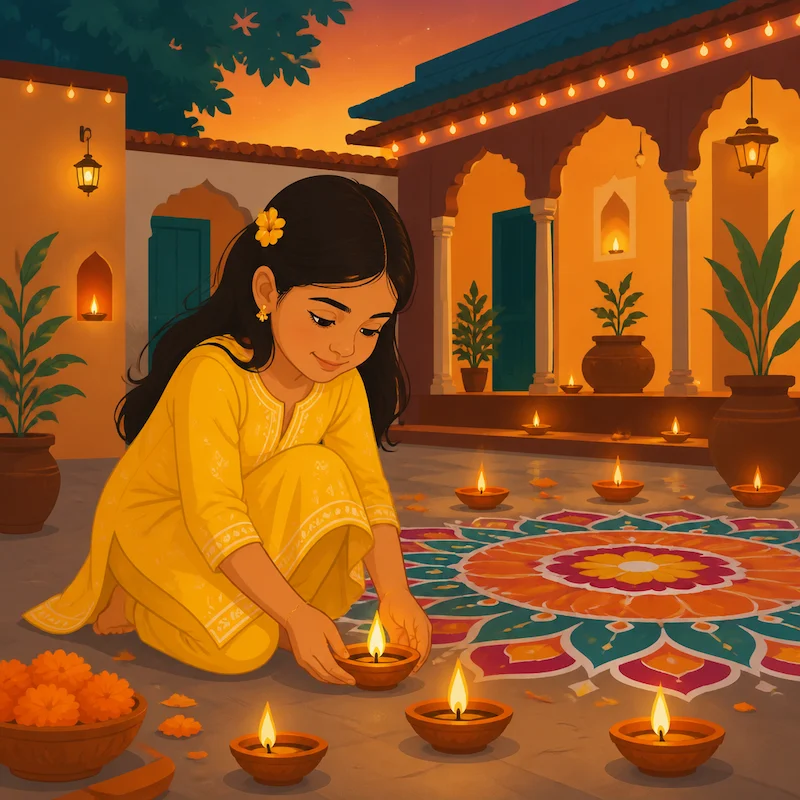
This is the story of Diwali for kids — the tale of a prince, a promise, and a city that refused to stay in the dark..
It is the night before Diwali, and eight-year-old Priya cannot sleep.
She lies on the cool floor of her grandmother’s house in Ayodhya, listening. Outside, she can hear people singing. She can smell the sweet scent of marigold garlands drifting through the open window. And she can see — from where she lies — the first tiny flicker of a diya being lit on the windowsill.
“Dadi,” she whispers. “Why do we light so many diyas? Why not just switch on the lights like we do every other day?”
Her grandmother smiles. She has been waiting for this question.
“Come,” says Dadi, patting the space beside her. “Let me tell you about the night that changed everything. The night a whole city lit up — for love.”
The Night Ayodhya Went Dark
A very long time ago, the city of Ayodhya was home to a beloved prince named Rama. Rama was everything a prince should be — brave, kind, and honest. Everyone in Ayodhya loved him. Children followed him through the marketplace. Farmers brought him the first fruits of their harvest. Old men bowed their heads as he passed.
But one day, because of a promise his father the King had once made to his queen, Rama had to leave. He had to go into the forest for fourteen long years — taking nothing but his bow, his courage, his beloved wife Sita, and his loyal brother Lakshmana.
The people of Ayodhya wept as they watched their prince disappear into the trees. The city felt cold without him — as if someone had blown out every lamp at once.
The Darkness Grows Deeper
The fourteen years in the forest were not easy. Rama, Sita, and Lakshmana faced wild animals, terrible storms, and the treachery of demons. But the worst moment came when the demon king Ravanacunning and powerful — sent a magical golden deer to lure Rama deep into the forest, then disguised himself as a holy man to trick Sita, and carried her away to his island kingdom of Lanka.
Rama’s heart broke. But he did not give up.
With the help of his devoted friend Hanuman — brave as thunder, fast as wind — and a great army of allies, Rama crossed the ocean to Lanka. After a mighty battle, Rama defeated Ravana. Light had won over darkness.
And now, at last, it was time to come home.
A Magical City of a Thousand Lights
When word spread through Ayodhya that Rama was returning — that very night — something extraordinary happened. No one said, “Let’s celebrate.” No one gave an order. It simply happened, the way only the most joyful things do — naturally, together, all at once.
Overwhelmed with happiness, the people of Ayodhya lit oil lamps in every home. Every window, every doorstep, every rooftop blazed with the warm, dancing light of thousands of clay diyas — guiding their beloved prince safely home through the darkness.
When Rama’s chariot rolled through the city gates, he looked out at the sea of golden light stretching in every direction — and he wept. Not from sadness, but from the kind of happiness that is so big it has nowhere else to go.
Sita held his hand. “They remembered us,” she said softly. “They waited,” said Rama.
And that night — the darkest night of the month — became the most luminous night the world had ever seen.
The Light Comes Home
“So that is why we light diyas?” asks Priya.
Dadi smiles warmly and gently squeezes Priya’s hand. “Every diya you light is a tiny reminder — that love is stronger than darkness, that good always finds its way home, and that the smallest light can push back the biggest shadow.”
For a moment, Priya simply watches the tiny flame already flickering on the windowsill. Then she gets up quietly, picks up the unlit diya beside it, and carefully lights it from the first.
The tiny flame flickers softly, filling the room with a warm golden glow. Outside, one by one, the whole street begins to glow.
Because every Diwali begins with just one little light.
“So everyone celebrates Diwali the same way?” Priya asked, looking at the glowing street outside.
Dadi laughed gently.
“Not exactly. Across India, every family celebrates a little differently—but every celebration carries the same message of light over darkness.”
Diwali Across India — One Festival, Six Stories
Celebrates Rama’s return to Ayodhya. Diyas, fireworks, and sweets are the heart of the celebration.
Celebrates Krishna’s victory over the demon Narakasura. Families wake before sunrise for a special oil bath ritual, then burst crackers at dawn — before most of North India is even awake!
Diwali is Kali Puja — honouring the fierce and compassionate Goddess Kali, the divine mother who protects her devotees from evil. Solemn, spiritual, and deeply moving.
Bandi Chhor Divas — the day Guru Hargobind Ji was freed from prison in 1619, along with 52 other kings.
Marks the day Lord Mahavira attained nirvana. A day of prayer, fasting, and deep reflection.
Diwali is also New Year’s Day! Businesses open new account books, and Goddess Lakshmi is welcomed home.
“Every diya says the same thing Ayodhya said to Rama:
We kept your light burning while you were away.”
Light is not just about brightness. It is about remembering, waiting, and love that does not give up. When you place a diya in your window tonight, you are doing something people have done for thousands of years — pushing back the dark, together.
Watch: How to Make a Paper Diya in Under a Minute!
See exactly how it’s done before you start. No words needed — just watch and copy! 🎨
Make a Paper Diya in 5 Steps!
No clay needed — just paper, colours, and five minutes. Let’s go! 🎨
- Draw a diya shape on your paper — it looks like a teardrop with a small pinched tip at one end. Cut it out.
- Draw a small teardrop shape inside the diya. This is the oil well where the wick sits.
- Decorate the outside with patterns — dots, small flowers, zig-zag lines, or anything you like. Use as many colours as you want!
- Draw a small flame at the pointed tip. Colour it bright yellow in the centre and orange at the edges.
- Write someone’s name on the back — a friend, a grandparent, anyone you want to send Diwali light to. Share it on WhatsApp! 💛
🎨 Did You Make a Paper Diya?
We want to see your creation! Send us a photo and you could be featured right here on Kidistan — as an official Young Artist of India 🌟
Be the first Young Artist on this wall!
Send us your paper diya on WhatsApp and we will add it here within 7 days.A Note for Parents
Diwali 2026 falls on 8 November. Whether your family celebrates with diyas and sweets, with prayers and fasting, or simply with the joy of being together — the story at the heart of Diwali is one every child can carry forever.
At Kidistan, we believe that knowing why we celebrate is just as important as the celebration itself. When children understand the story behind the diya, the light means more.
Save this page and come back every festival season — we add new stories, crafts, and activities throughout the year. 🌟
